

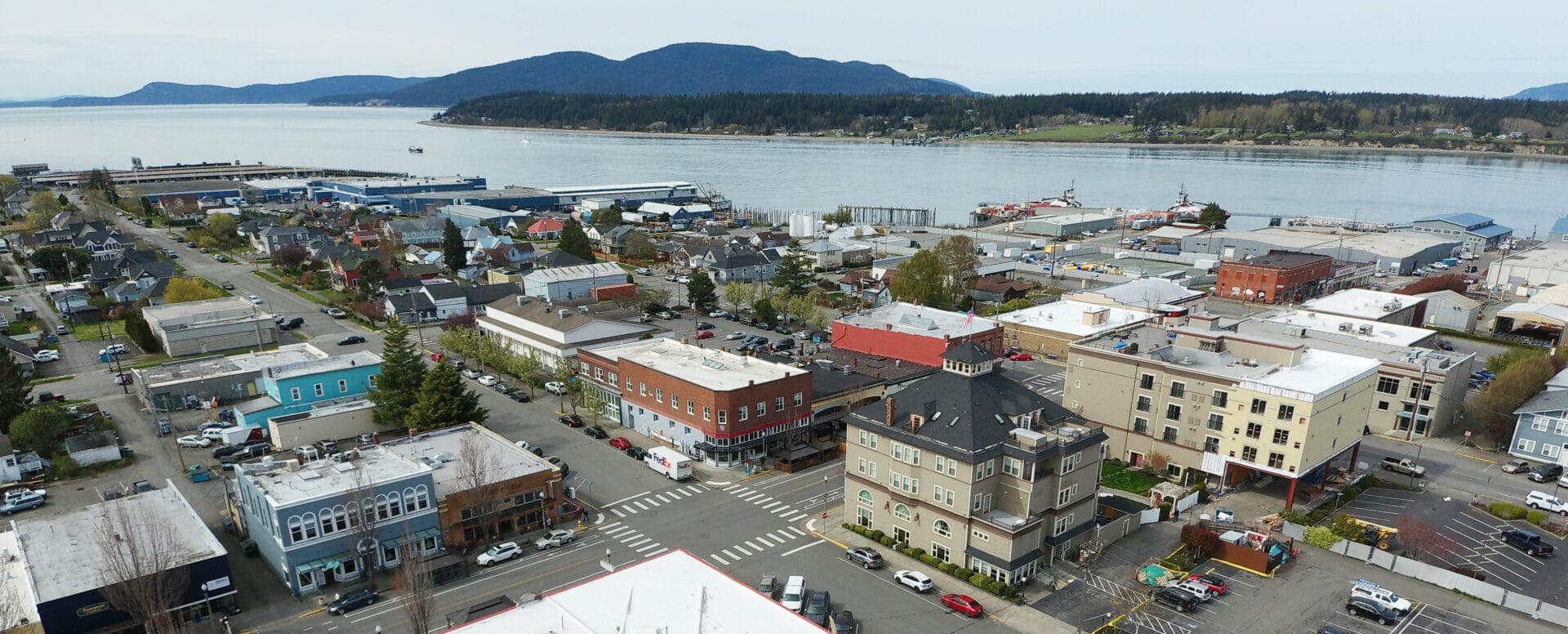
MAKERS, Leland Consulting Group, and Parametrix helped the City of Anacortes fully update its Comprehensive Plan and add a new Climate Element. After two years of public engagement and policy development, the plan was adopted in December 2025. Our team has worked with Anacortes on numerous projects and was proud to work with the community on a reinforced foundation for its long-term vision on housing, economic growth, and high quality of life. The updated plan also reflects our team’s shared commitment to rigorous analysis, transparent public engagement, and legally defensible policies and regulations.
The Case
In January 2026, the Comprehensive Plan and updated zoning regulations were appealed to the Growth Management Hearings Board (GHMB) by several Anacortes residents. The GMHB is a forum for Washington residents and local governments to handle legal complaints against actions conducted under the Growth Management Act (GMA), the Shoreline Management Act, and the State Environmental Policy Act (SEPA).
In case number 26-2-0001c, William Turner and Ian Munce et al. v. City of Anacortes, the petitioning residents made five claims about Anacortes’s compliance with state law (and noted which GMA goals are related):
- The city is not accommodating housing affordable to all segments of the population (Goal 4).
- The city did not provide for meaningful, early, and continuous public participation (Goal 11).
- The city did not conduct early environmental review, consider alternatives, and provide reasonably sufficient information and balanced housing interests against the environment (Goal 10).
- The city relied upon an outdated Shoreline Master Program (Goal 12).
- The city did not conduct meaningful analysis of the funding capacity for the infrastructure necessary to support planned density and housing aspirations (Goal 12).
The GMHB dismissed every claim against Anacortes and found that the petitioners failed to meet the burden of proof. Comprehensive plans and development regulations are presumed valid upon adoption, setting a high bar for challengers to demonstrate that a local government action is out of step with the Growth Management Act. The MAKERS-Leland team also provided Anacortes with high-quality data analysis, extensive public engagement activities, and actionable planning policies that helped the City rise to the challenge.
Reviewing the Claims
Claim #1: Affordable housing capacity. The petitioners compared Anacortes to Future v. City of Mercer Island (case number 25-3-0003). The GMHB dismissed this comparison on its face, saying, “none of the shortcomings identified in the Mercer Island case are present here.” However, the board did not offer a detailed analysis that may be helpful for precedent in other local jurisdictions.
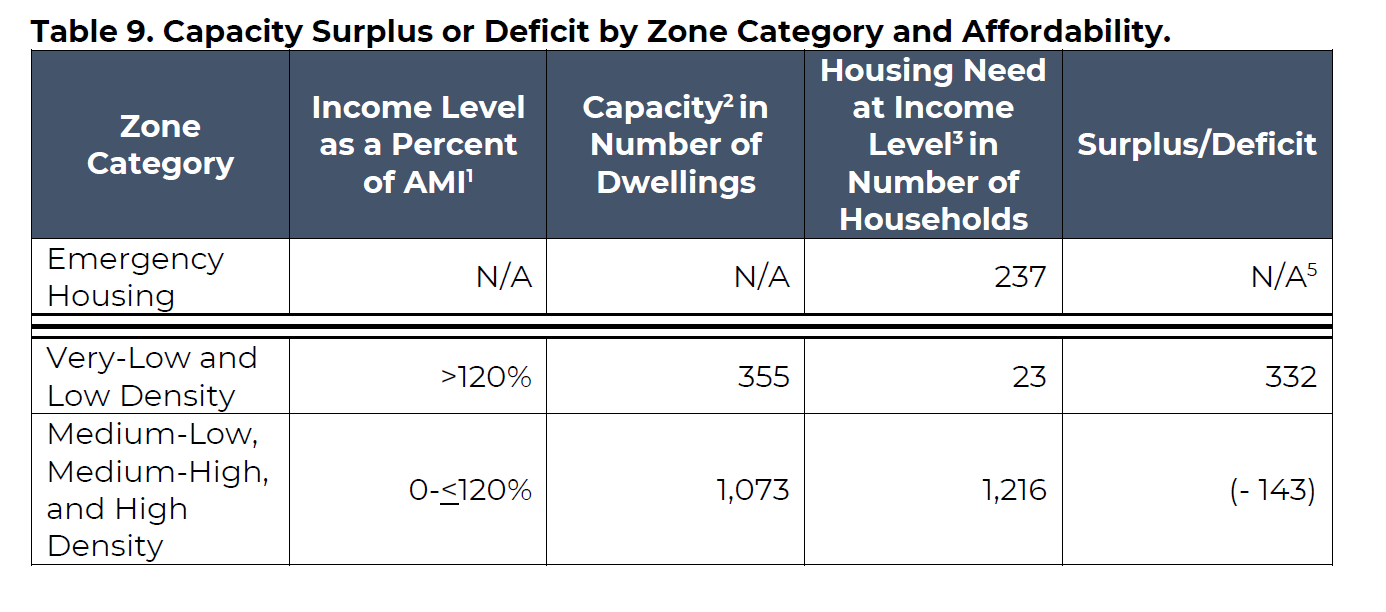
Table from the 2024 Mercer Island Comprehensive Plan showing capacity information by aggregated income levels, at issue in the GMHB case.
In the Mercer Island case, the GMHB found that aggregated income levels in the land capacity analysis obscured the city’s lack of 20-year residential land capacity for low- and moderate-income households, in particular obscuring the subsidy needed to provide housing at various income bands for households earning under 80% of area median income (AMI). This made it appear the City did not need to take substantial action to support and identify the subsidies needed to construct low-income housing.
For the Anacortes Housing Action Plan, MAKERS and Leland oriented the analysis on a zone-by-zone breakdown rather than income-bands, using Department of Guidance that was available at the time the land capacity analysis was done in 2022 (House Bill 1220 was passed only a year earlier in 2021). Later, the updated Housing Element included the disaggregated housing needs at the 0-30%, 30-50%, and 50-80% AMI levels but still aggregated these low-income bands for identifying capacity surplus or deficit. Although recent GMHB decisions have presented somewhat differing opinions on the aggregation of need and capacity, in this case, it appears the combination of data our team presented for income-level needs, analysis of barriers to production, and zone-by-zone capacity – even across separate planning documents – was sufficient compared to Mercer Island’s approach. Anacortes’s highly detailed HAP was likely also a beneficial factor, as it contains numerous code and mapping strategies to increase multifamily housing capacity, along with a recommendation to restart a multifamily tax exemption program.

Figure from the 2025 Anacortes Comprehensive Plan showing housing needs by income level.
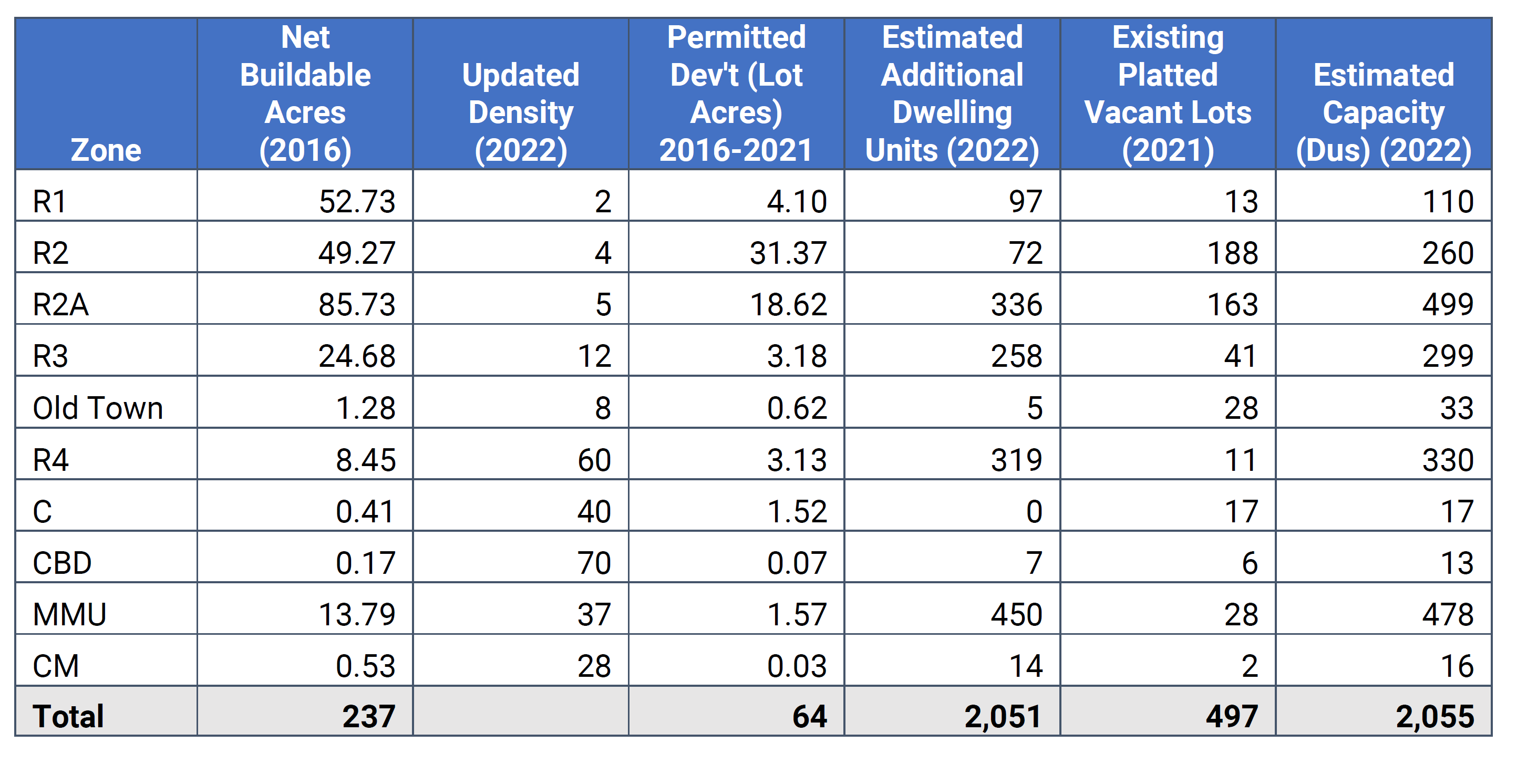
Excerpt from the land capacity analysis for the 2023 Anacortes Housing Action Plan showing housing capacity by zone.
Overall, the Anacortes HAP is an excellent housing planning tool with detailed data on housing needs with informed strategies for serving lower-income households. The City has already started implementing many of the HAP recommendations.
Claim #2: Public participation. The petitioners specifically argued that the City’s fee to submit an annual comprehensive plan application prevents public participation. In response, the City pointed out that there was no fee for submitting public comments during the periodic update planning process. A councilmember also offered to freely sponsor 11 of the petitioner’s proposed amendments at the time, but the petitioner declined. The GMHB denied another argument about the impacts of schedule delays on public participation, pointing out that Anacortes’s public participation plan (developed by MAKERS) notified readers that the schedule could be adjusted as engagement needs evolve at any point during the planning process.
Claim #3: Environmental review. The petitioners argued the SEPA Checklist was faulty and the Determination of Non-Significance was insufficiently detailed, resulting in an inappropriate balancing of beneficial and adverse impacts. The GMHB found the complaint on this matter was insufficiently detailed and without proof, and the City had adequately considered the environment, including in the plan’s Environment & Conservation Element. MAKERS advised on the SEPA checklist approach, and MAKERS and Parametrix co-developed the new Anacortes Climate Element, which details a number of goals and policies related to environmental protection and human health that could be considered mitigating factors of development activity anticipated by the plan.
Claim #4: Shoreline planning. The petitioners did not provide any arguments, so the GMHB did not provide a detailed ruling on this issue.
Claim #5: Infrastructure. The petitioners claimed the City did not conduct meaningful analysis of the funding capacity for infrastructure. The City argued that it did, with a focus on water, sewer, and stormwater.
The petitioners made a particular point about the impacts of promoting middle housing. The City determined that over 20 years, middle housing-friendly zoning (informed by MAKERS and Leland in the HAP) would result in a modest housing unit capacity increase of 4-5%, well within Anacortes’s infrastructure demand planning assumptions. The GMHB also found the City adequately reviewed development patterns and trends in its urban growth area.
The Benefits of a Knowledgeable Planning Team
Cities and counties are navigating increasingly complex demands of the Growth Management Act, housing affordability, climate policy, infrastructure planning, and public participation. When plans face legal scrutiny, the quality of the work and process behind them is paramount. Anacortes’s successful defense against every claim in this case underscores the value of partnering with an experienced planning team.
MAKERS brings the technical expertise, municipal planning experience, and collaborative approach needed to turn these challenges into actionable, defensible plans. We build GMA-consistent plans, durable planning frameworks, and provide robust analysis, engagement, and policy.
If your community is preparing for its next Comprehensive Plan update or a major planning initiative, get in touch with our teams to start down the road to success.